Are Knife Blocks Sanitary?
Knife blocks are sanitary only if you clean and dry them regularly. A block with deep slots and no airflow can hold moisture and food bits, so wipe the slots often and never slide a wet knife back in.
On this page (7 sections)
- Are knife blocks sanitary in normal kitchen use?
- What makes a knife block unsanitary?
- How do you keep a knife block clean and sanitary?
- Is a magnetic knife strip more sanitary than a block?
- Does block material change how sanitary it stays?
- How should you store knives if a block makes you uneasy?
- Are knife blocks sanitary enough to keep using?
Knife blocks are sanitary only if you clean and dry them regularly. A block with deep slots and no airflow can hold moisture and food bits, so wipe the slots often and never slide a wet knife back in.
Whether your knife blocks are sanitary comes down to moisture. A block is a storage tool, not a sterile one.
How clean it stays depends almost entirely on what you put into it and how often you empty and wipe it.
Are knife blocks sanitary in normal kitchen use?
A knife block stays sanitary when knives go in clean and dry and the block gets wiped out regularly. Skip either habit and the closed slots become a damp, dark space where bacteria and mold can build up.
The design is the weak point. Slots are narrow and deep, so crumbs and moisture collect at the bottom where a cloth struggles to reach.
Wood can also soak up water, which makes a wet blade a bigger problem than in plastic.
That doesn't make blocks unsafe. It makes them a storage choice that needs upkeep.
A block you wipe monthly and load only with dry knives is fine for everyday home cooking.
The real risk is the lazy version: a knife rinsed and returned while still dripping, a block never cleaned, and food residue building in the base over time. That version is not sanitary.
What makes a knife block unsanitary?
Three things turn a block into a problem: moisture, food residue and no airflow. Each one feeds the next, and a block that stays damp never gets the dry-out it needs.
- Wet knives put water straight into a closed slot. Wood absorbs it and stays damp.
- Bits of meat, fish or vegetables left on a blade transfer into the slot.
- Dust and grease settle on top and fall in when knives are pulled out and pushed back.
- Closed blocks have no air movement inside, so the base dries slowly.
Cross-contamination matters too. A knife used on raw chicken and wiped rather than washed can leave bacteria in its slot.
The next clean knife in the same slot picks some of that up.
Mold is the visible sign. Dark spots or a musty smell in the slots mean the block has stayed wet too long.
At that point, deep cleaning or replacing the block is the honest answer.
How do you keep a knife block clean and sanitary?
Clean the block about once a month in a busy kitchen and after any raw meat prep. The routine is short, and it removes the conditions bacteria need.
- Empty every slot and set the knives aside.
- Turn the block upside down and tap out loose crumbs over the bin.
- Wrap a thin cloth or a soft bottle brush in mild soapy water and wipe each slot to the bottom.
- Wipe the outside and the top surface, including the area between slots.
- Let the block air dry fully, slots down or on its side, before reloading.
- Load only clean, completely dry knives.
Never soak a wooden block or put it in the dishwasher, since water can split the wood. Plastic blocks tolerate more, but follow the maker's care instructions.
For wooden blocks, a light food-safe mineral oil now and then helps the wood resist moisture. Skip vegetable oil, which can go rancid.
Which cleaning brush helps for blades and cutlery?
A dedicated brush with opposed bristles cleans both sides of a blade at once. That matters when you're washing knives before they go back in the block, since a properly washed blade is the first step in block hygiene.
The Joseph Joseph BladeBrush has a wrap-around design with bristles on both sides and a textured handgrip. You hold the knife and pull it through the brush, so your hand stays away from the edge.
It's wash by hand.
This brush suits anyone who wants a safe, consistent way to clean long chef knives and utility blades. It's a small addition that makes the "wash and dry before storing" habit easier to keep.
Skip it if you already have a brush you like. The bigger win is simply drying each knife before it goes in the block.
Is a magnetic knife strip more sanitary than a block?
A magnetic knife strip is easier to keep sanitary because blades hang in open air and the surface wipes clean in seconds. There are no slots to trap moisture, so knives dry faster and nothing hides inside.
That's the main argument for switching. A block hides its dirt in narrow slots; a strip puts everything in view.
You can see a smudge or a crumb and wipe it off.
The trade-off is exposure. A strip leaves blades open to dust and kitchen splatter, and it needs to sit out of reach of children.
A block hides knives away, which some households prefer.
Neither is automatically safe. A strip that never gets wiped collects grease on the bar; a block that never gets cleaned traps moisture.
The difference is that the strip is far easier to inspect and clean.
Which magnetic strip works for a typical kitchen?
The Modern Innovations 16 Inch Stainless Steel Magnetic Knife Bar is a stainless steel strip with a strong magnetic surface. Its satin finish wipes clean easily, so there's no slot to scrub.
At 15 3/4 inches of actual length, it holds more knives than most blocks while still fitting into a nook. The maker says the magnetic surface holds even large knives securely.
It mounts with the included hardware and illustrated instructions, and it works as a general tool or art-supply organizer too.
This strip suits anyone who wants visible, wipe-clean storage and has wall space near the prep area. Keep it high if children are in the house.
Skip it if you want knives hidden or have no free wall. A block still works there, as long as you keep it clean.
Which magnetic block set suits someone who wants the block look?
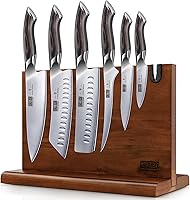
The Hoshanho 7-Piece Magnetic Block Set combines a knife set with a double-sided acacia wood magnetic block. The block uses strong built-in magnets to hold blades on its outer faces rather than hiding them in slots.
The set includes six knives plus the holder: an 8 inch chef knife, 7 inch santoku, 7 inch nakiri, 7 inch fillet, 6 inch utility and 3.75 inch paring knife. The blades are 10Cr15CoMoV high-carbon stainless steel at up to 60HRC with a 15 degree edge, and the handles are Pakkawood.
Because the knives sit on the outside, the block dries better than a slotted one and you can wipe the faces easily. It keeps the block look without the hidden-slot problem.
This set suits a home cook who wants Japanese-style blades and a block that's easy to keep clean. It also comes in a gift box.
Skip it if you only need storage and already have knives.
Does block material change how sanitary it stays?
Material changes how much care a block needs. Plastic is the easiest to clean, wood needs dry handling and oiling, and bamboo sits between the two.
None of them is self-cleaning.
Plastic blocks resist water and wipe down quickly, and some go in the dishwasher. They show stains over time but don't absorb much moisture.
Wood blocks look better and hold knives gently, but they absorb water. They need full drying, occasional mineral oil and no soaking.
Bamboo behaves similarly but is denser and often more water-resistant.
Magnetic blocks in wood or stainless have fewer hidden surfaces. A stainless bar is the easiest to keep clean of all.
A wood magnetic block still needs wiping, but its faces are open to air.
Whichever material you pick, the habits matter more than the material. Dry knives and regular wiping do most of the work.
How should you store knives if a block makes you uneasy?
If hidden slots bother you, move to open storage: a magnetic strip, a wall rack or a drawer insert with open slots. Each one lets blades dry and makes cleaning simple.
An in-drawer insert is a middle option. It holds knives flat and separate, and it's easy to lift out and wipe.
It does keep blades enclosed, so knives still need to go in dry.
Whichever route you take, the same rules apply. Wash and dry each knife before storage, keep raw-meat knives separate until washed, and wipe the storage surface regularly.
If you're building a set around cleaner storage, our guide to the best knife set with a magnetic block covers options that keep blades out in the open. A smaller 3 piece knife set is also easier to manage and clean than a full block of rarely used knives.
Are knife blocks sanitary enough to keep using?
Yes, a knife block is sanitary enough for most homes when you wipe it monthly and store only clean, dry knives. The block isn't the problem; a wet blade and a neglected slot are.
If you want less upkeep and easier inspection, a magnetic strip or magnetic block removes the hidden-slot issue. Either way, the routine is the same: clean the blade, dry it fully, and keep the storage surface wiped.
Before you buy a new set, read how to choose a chef knife for size, steel and handle advice. For the wider picture on blocks, sets and storage, our kitchen knife set buying guide puts it all in one place.
Then decide whether your next block is slotted or magnetic, and clean it from day one.
Frequently asked questions
How often should you clean a knife block?
Clean the slots about once a month in a busy kitchen and after any raw meat prep. Wipe each slot with a damp cloth and a little soap, then let the block air dry fully before putting knives back.
Wipe more often if the block sits near the stove.
Can bacteria grow inside a knife block?
Yes, bacteria can grow when moisture and food residue stay in the slots. Dark, narrow spaces that never dry are the risk.
Cleaning and fully drying the block, and storing knives clean and dry, removes the conditions bacteria need.
Should you put knives away wet in a block?
No. A wet blade puts moisture straight into a closed slot.
Dry the knife completely with a towel first, then store it.
This one habit does more for block hygiene than any cleaning product.