Types of Knives in a Knife Block Explained
A knife block usually holds a chef's knife, a paring knife and a serrated utility or bread knife as its core tools, plus extras like a santoku, boning knife and steak knives in bigger sets. Most home cooks use those first three for nearly every task.
On this page (11 sections)
- Which knife does most of the work in a block?
- What does a paring knife do that a chef's knife can't?
- Why does every block include a serrated knife?
- What is a santoku doing in a Western knife block?
- What is a boning knife and do you need one?
- How many steak knives should a block hold?
- Which extra tools round out a knife block?
- How many knives do you really need in a block?
- Which knife block set fits each kind of cook?
- What should you check before buying a knife block?
- The bottom line on types of knives in a knife block
A knife block usually holds a chef's knife, a paring knife and a serrated utility or bread knife as its core tools. Bigger sets add a santoku, boning knife, steak knives and sometimes shears or a honing steel.
Those first three handle nearly every job in a home kitchen.
The rest of the block is where sets differ, and where most buyers overpay for blades they never touch. This guide walks through the types of knives in a knife block one slot at a time, so you can match a set to the cooking you actually do.
Which knife does most of the work in a block?
The chef's knife is the workhorse of any block. Its long blade and curved belly let you rock through herbs, onions and meat with one tool, which is why nearly every set leads with an 8-inch version.
The 8-inch chef's knife covers more ground than any other blade here. Its width and length give you room to guide the cut with your knuckles, and the curve lets the tip stay on the board while the heel comes down.
Henckels builds its Statement set around an 8-inch chef's knife as the all-rounder for chopping herbs and dicing onions. That framing matches how most cooks actually work: reach for the big knife first, then switch only for small or delicate jobs.
Blade length matters more than brand here. A chef's knife under 6 inches starts to feel cramped for big vegetables, while one over 10 inches gets unwieldy on a small board.
Eight inches is the safe middle for most hands and counters.
If you cook mostly vegetables and stir-fries rather than roasts, a santoku can take the lead role instead. That trade-off gets its own section below.
Rule: if a block's chef's knife is shorter than 6 inches or longer than 10, look at a different set unless you know your board and hands suit it.
What does a paring knife do that a chef's knife can't?
A paring knife handles small, precise cuts where a big blade gets in the way. Peeling fruit, trimming stems, coring tomatoes and deveining shrimp are its jobs, and its short blade gives you control a chef's knife can't match.
Most blocks include a 3 to 4-inch paring knife, and that size covers nearly every small task. The Henckels set pairs a 3-inch parer with its larger blades, and the Ninja system carries a 3.5-inch version.
A paring knife is also the safest blade for work in your hand rather than on a board. You can rotate an apple or trim a strawberry without the long blade of a chef's knife swinging past your fingers.
The trade-off is reach. A paring knife can't section a pineapple or break down a cabbage, so it never replaces the chef's knife.
It complements it.
Some blocks add a second small knife, often labeled a utility knife at 5 inches. That size sits between the two: long enough for sandwich prep and trimming green beans, short enough to feel precise.
It's useful, but not essential.
Rule: a block without a paring knife is missing a basic tool; skip it unless you already own one you like.
Why does every block include a serrated knife?
A serrated knife cuts what a straight edge crushes. Bread, tomatoes, citrus and cake all have soft interiors and tougher skins, and the sawing teeth bite through the crust or skin without squashing what's inside.
Blocks usually carry this blade as a 5-inch serrated utility knife or an 8-inch bread knife. The shorter utility version suits tomatoes, sausage and small rolls.
The longer bread knife takes on full loaves and large cakes.
Henckels includes a 5-inch serrated utility knife for foods with a soft interior and hard exterior, and an 8-inch bread knife for loaves. Ninja's 14-piece system adds an 8-inch bread knife as well.
The serrated edge stays sharp a long time because you cut on the teeth rather than a fine edge. That also means it can't be honed on a steel like a straight blade, so treat it as a separate tool with its own care.
If you bake bread or eat a lot of tomatoes, this blade earns its slot quickly. If neither applies, it still handles sausage and fruit, so it rarely sits idle for long.
Rule: choose a set with both a serrated utility and a bread knife if you bake; otherwise the utility knife alone is enough.
What is a santoku doing in a Western knife block?
A santoku is a Japanese-style all-purpose knife with a shorter, flatter blade and a hollow edge that helps food release. It does much of the same work as a chef's knife, but with a different feel and a different cutting motion.
The blade usually runs 5 to 7 inches with a sheep's-foot tip rather than a pointed one. You chop straight down instead of rocking, and the grantons, the small oval indentations along the edge, keep slices from clinging to the blade.
Henckels puts both a 5-inch and a 7-inch hollow-edge santoku in its Statement set. Ninja includes a 5-inch santoku in its 14-piece system.
Having both a chef's knife and a santoku lets you pick by task and by hand size.
Smaller hands often prefer the santoku's shorter blade and lighter feel. Cooks who do a lot of rocking cuts, mincing and scooping with the blade tend to favor the chef's knife.
Some sets push the santoku as a replacement for the chef's knife. Treat that as marketing rather than a rule: they overlap, but the chef's knife still wins on long cuts and heavy chopping.
Rule: pick a set with both if you can; if you must choose one, keep the chef's knife and skip the santoku.
Where a nakiri and utility knife fit
Some Japanese-style blocks add a nakiri, a rectangular vegetable knife with a flat edge. It chops and slices produce cleanly and scoops the cut food with its broad blade.
The Hoshanho 7-piece set takes this route. It pairs an 8-inch chef's knife and a 7-inch santoku with a 7-inch nakiri and a 6-inch utility knife, plus a fillet knife and paring knife.
The nakiri is a specialist: superb for cabbage, carrots and greens, less useful for meat and fish. Utility knives fill the sandwich-and-trim gap that paring knives leave.
Rule: choose a nakiri only if vegetables dominate your cooking; otherwise spend that slot on a bread knife.
What is a boning knife and do you need one?
A boning knife has a narrow, flexible blade for separating meat from bone and trimming silver skin. It's the one blade in a block that most home cooks can live without.
The flexible curve lets the blade follow the shape of a bone without cutting into the meat. That matters when you break down whole chickens, bone out a leg of lamb or fillet a fish.
Ninja's 14-piece system includes a 5-inch boning knife alongside its chef's, bread, santoku and utility knives. That's a set built for cooks who handle larger cuts rather than only buying pre-cut meat.
If you buy whole birds or bulk meat and portion it yourself, the boning knife earns its place and can save money at the counter. If your meat arrives trimmed and cut, it will sit in its slot.
The knife also works as a general trimmer for fat and sinew, so it isn't useless without whole cuts. Just don't let it push a more useful blade out of the block.
Rule: buy a set with a boning knife only if you break down meat; otherwise prefer a set that spends that slot on a bread knife or a second utility knife.
How many steak knives should a block hold?
Steak knives in a block come in sets of six, sometimes four, and suit anyone who serves steak or roasts. For households that rarely serve whole cuts of meat, those slots hold knives that never leave the block.
A serrated steak knife cuts meat cleanly without tearing the fibers the way a straight edge can on a fibrous steak. That's why steakhouse-style serrations appear on most sets, including the six in the Henckels Statement set.
Six is the usual count because it seats a family or a small dinner party. If you regularly host more than six at a meat dinner, you'll need extra knives outside the block anyway.
A block with six steak knives plus the core tools runs large. On a small counter, that extra footprint costs more than the steak knives add, so weigh the space.
If meat is rare in your kitchen, look for a set with fewer steak knives and better core blades. A block with four steak knives or none at all leaves more room for the knives you reach for daily.
Rule: count your usual dinner guests; if you never seat more than four at a meat meal, a set with four steak knives or fewer is the better fit.
Which extra tools round out a knife block?
Shears and a honing steel are the extras worth having, while some slots exist mostly to fill the block. Knowing which is which stops you paying for dead weight.
Kitchen shears snip herbs, trim poultry and open packaging, and they're one of the most-used tools in a busy kitchen. Henckels includes a pair with its 15-piece set, and Ninja adds shears to its 14-piece system.
A honing steel realigns a straight edge between sharpenings. Henckels includes a 9-inch sharpening steel in its block; Ninja takes a different route with a built-in stone sharpening wheel in the block itself.
Its lever engages the blade at the set angle, so you don't need a separate steel.
Some blocks add a second utility knife or a carving fork. A carving fork helps with roasts, but most cooks can skip it without noticing.
These are the slots to ignore when comparing sets.
If the extra tools don't help your cooking, they add cost and counter space. The useful extras are shears, a sharpening steel or built-in sharpener, and a block design you can keep clean.
Rule: value shears and a sharpening steel; treat carving forks and duplicate utility knives as filler.
Block or magnetic strip
The storage itself is a tool choice. A traditional slotted block hides knives but traps crumbs, while a magnetic strip or magnetic block holds blades in the open where you can see and wipe them.
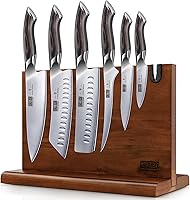
The Hoshanho set uses a double-sided acacia magnetic block with strong magnets that hold the blades flat. That's easier to keep clean than slotted wood.
Our guide to knife block hygiene covers the cleaning differences in detail.
Rule: choose a slotted block for hidden storage; choose a magnetic block if you want to see and wipe the blades easily.
How many knives do you really need in a block?
Three knives do most of the work in a home kitchen: a chef's knife, a paring knife and a serrated knife. Everything else in a big block is either a specialist or a backup.
That's why a 3-piece set covers basic cooking well. A 3 piece knife set with those three blades and a good board handles everyday meals without the counter footprint of a 15-slot block.
Bigger blocks earn their keep when their extras match your habits. A baker uses the bread knife and steak knives constantly; a vegetarian reaches for the nakiri and santoku; someone who breaks down whole chickens wants the boning knife.
The math is simple: count the slots you'll use weekly. A 15-piece set makes sense if most of those blades get regular work, and wastes money and space if half of them stay pristine.
If you'd rather build slowly around knives you choose yourself, read knife set vs individual knives for the trade-offs in cost and control.
Rule: buy the smallest block whose core and specialist blades you'll actually use, not the largest set on sale.
Which knife block set fits each kind of cook?
Match the block to your cooking habits, not to the slot count. The three sets here cover a full Western kitchen, a sharpening-focused buyer and a Japanese-style vegetable cook.
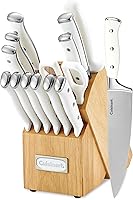
The Henckels Statement 15-piece set suits a household that cooks across the week and hosts often. It leads with the 8-inch chef's knife, adds both santoku sizes, a bread knife, six steak knives, shears and a 9-inch sharpening steel in a hardwood block.
Its single-piece stamped blades are lighter than forged ones and the maker backs them with a lifetime warranty against manufacturing defects.
The Ninja NeverDull 14-piece system fits a cook who wants sharpening built in. Its forged German stainless steel blades sit in a block with a stone sharpening wheel; you swipe the lever and the wheel restores the edge at a set angle.
It includes chef, bread, santoku, boning, utility and paring knives plus six steak knives and shears.
The Hoshanho 7-piece set suits a cook who works mostly with vegetables and wants a magnetic block. Its 10Cr15CoMoV high-carbon stainless blades are vacuum heat treated to 60HRC at a 15° edge, and the double-sided acacia magnetic block holds them in the open.
If a wall strip appeals more than a counter block, compare designs in our roundup of the best knife set with magnetic block.
Rule: pick the Henckels set for the widest range of tasks, the Ninja for built-in sharpening, and the Hoshanho for Japanese-style blades and a magnetic block.
What should you check before buying a knife block?
Check the core three blades first, then the construction and the block design. The extras matter only after those basics suit how you cook.
Construction affects weight and feel. Stamped blades like the Henckels set are lighter and easier to maneuver; forged blades like the Ninja set carry more weight and a full bolster.
Neither is better for every cook, so handle the balance you prefer.
Check the handles too. Henckels uses curved triple-rivet stainless handles with a steel endcap; the Ninja set has an ergonomic grip with a full tang.
Hoshanho uses Pakkawood. Grip comfort decides which knife you reach for daily.
Look at the block's footprint and how you'll clean it. A 14-slot hardwood block takes more counter space than a 7-knife magnetic holder, and slotted wood needs more care than an open magnetic surface.
Finally, confirm the set's warranty and sharpening support. A built-in sharpener or a honing steel keeps edges usable longer, which matters more than one extra blade in the block.
Rule: judge a set by its chef's, paring and serrated knives first, its handles and block second, and its specialist blades last.
The bottom line on types of knives in a knife block
The types of knives in a knife block matter less than which ones you'll use. A chef's knife, paring knife and serrated knife cover nearly every home kitchen task, and the rest are specialists you should buy only when your cooking calls for them.
Pick the Henckels Statement 15-piece set if you cook widely and want every common blade plus shears and a steel. Pick the Ninja NeverDull 14-piece system if you want forged blades and sharpening built into the block.
Pick the Hoshanho 7-piece set if vegetables dominate and you like a magnetic block you can wipe clean.
Whatever you choose, keep the core three sharp and store them dry. That habit does more for your cooking than any extra slot in the block.
Frequently asked questions
What are the most common types of knives in a knife block?
Chef's knives, paring knives and serrated utility or bread knives appear in almost every block set. Larger blocks add a santoku, boning knife, steak knives and sometimes shears or a honing steel.
How many knives do I actually need in a block?
Three do most of the work: a chef's knife for chopping and slicing, a paring knife for small precise cuts and a serrated knife for bread and tomatoes. A block with those three plus a honing steel covers everyday cooking.
Is a santoku better than a chef's knife?
Neither wins outright. A santoku's hollow edge helps food release and its shorter blade suits smaller hands, while a chef's knife has a longer blade for rocking cuts and heavier chopping.
Many blocks include both so you can choose per task.
What is a boning knife used for in a block set?
A boning knife has a narrow, flexible blade for trimming meat away from bone and silver skin. Home cooks who buy whole chickens or break down large cuts use it; anyone buying pre-cut meat can leave it in the block.
Do steak knives in a block set matter?
They matter if you serve steak or roasts regularly, since a serrated steak knife cuts meat cleanly without tearing. If you rarely serve meat, those slots hold knives you will not reach for, and a smaller set is the better buy.
Are knife blocks sanitary?
A knife block can collect dust and crumbs in its slots, especially if knives go in damp. Wash and dry each knife before storing it, and choose a slotted or magnetic design you can wipe clean.
Our guide to knife block hygiene covers the details.