What Does High Carbon Stainless Steel Mean in Knives?
High carbon stainless steel combines carbon that can support a hard, edge-holding blade with chromium that helps resist rust and stains. To choose a knife, compare its shape, sharpening options, construction, and care needs as well as its steel.
On this page (10 sections)
- What is high carbon stainless steel in a knife?
- What does carbon do in knife steel?
- What does chromium add?
- How should you care for high carbon stainless steel knives?
- Does high carbon stainless steel need frequent sharpening?
- Which knife sets use high carbon stainless steel?
- Is high carbon stainless steel better than German or Japanese knife steel?
- How do you choose a high carbon stainless steel knife?
- What are common mistakes with high carbon stainless steel?
- What does high carbon stainless steel mean for your choice?
High carbon stainless steel combines carbon that can support hardness and edge holding with chromium that helps a blade resist rust and stains. If you're asking what is high carbon stainless steel, the short answer is a steel blend intended to balance edge support with corrosion resistance.
For a kitchen knife, the steel is only one part of the choice. Blade shape, edge angle, handle, sharpening access, and care habits affect how well a knife fits your kitchen.
What is high carbon stainless steel in a knife?
High carbon stainless steel is steel with added carbon and enough chromium to improve corrosion resistance. Carbon can help steel become hard, while chromium helps protect the surface from rust and staining.
“Stainless” describes resistance, not immunity. A blade can still spot or corrode if food, moisture, or salt stays on it for too long.
The phrase doesn't identify one exact steel formula. Two knives can both use high carbon stainless steel and differ in their composition, heat treatment, blade shape, and edge.
What does carbon do in knife steel?
Carbon helps steel reach the hardness needed to take and hold a cutting edge. Hardness can help with edge life, but it's only one part of a knife's performance.
A hard blade can be less forgiving if it's twisted, dropped, or used against a hard surface. Blade design and heat treatment also affect how it behaves, so the carbon label can't promise a specific result.
Is high carbon stainless steel sharper?
No, the steel label alone doesn't make a knife sharper. Sharpness depends on edge geometry and how well the blade has been sharpened.
A well-sharpened knife with a modest steel description can cut better than a dull knife with premium-sounding terms. For help matching blade shapes and sizes to your kitchen, see how to choose a chef knife.
What does chromium add?
Chromium helps steel resist rust and staining. That added resistance suits everyday kitchen use, but it doesn't remove the need to clean and dry a blade.
Acidic foods, salt, and standing water can leave marks or damage a blade over time. Rinse off food after cutting, then dry the knife before putting it away.
How should you care for high carbon stainless steel knives?
Wash and dry knives promptly, then store them so the edges don't hit other tools. Follow the care instructions for each set, especially when they specify hand washing.
Hand washing is a sensible habit for many kitchen knives because dishwashers expose blades and handles to heat, detergent, and movement. Check whether kitchen knives are dishwasher safe before putting a set in the machine.
Store knives in a block, on a suitable magnetic strip, or in blade guards in a drawer. Our guide to storing kitchen knives safely at home covers those options.
Does high carbon stainless steel need frequent sharpening?
Every knife eventually needs its edge maintained. How often depends on use, the foods you cut, the board you use, and how you sharpen it.
A honing steel can help realign an edge between sharpenings, but it doesn't replace sharpening once the blade becomes dull. A built-in sharpener or separate sharpener makes upkeep more convenient, though you should use a method suited to the knife.
The imarku set pairs high carbon stainless steel knives with a block that has a built-in sharpener.
The Cuisinart set includes an 8-inch sharpening steel, and the Amazon Basics set includes an 8-inch sharpener. Those tools work differently, so read the care instructions and learn how to use the one included with your set.
Which knife sets use high carbon stainless steel?
These 4 block sets pair high carbon stainless steel blades with different tools, storage, and knife selections. Choose by the knives you use, the sharpening method you prefer, and how much counter space you have.
The Cuisinart set is a forged 15-piece set with a chef knife, slicing knife, santoku, utility knife, 2 paring knives, 6 steak knives, sharpening steel, shears, and a wooden block.
The imarku set includes a chef knife, bread knife, slicing knife, santoku, utility knife, paring knife, 6 steak knives, shears, and a hardwood block with a built-in sharpener. Consider it if you want a sharpening option built into the storage block; skip it if you prefer a separate sharpening tool or a smaller set.
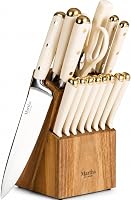
The Martha Stewart Lockton set includes a chef knife, bread knife, santoku, utility knife, paring knife, 8 steak knives, a sharpening rod, shears, and an acacia wood block. Its care instructions call for hand washing, which makes it a better match for someone willing to wash and dry knives at the sink.
The Amazon Basics 14-piece set includes a chef knife, slicing knife, bread knife, utility knife, paring knife, 6 steak knives, scissors, sharpener, and pinewood block. Its care directions call for hand washing and immediate drying, so skip it if you need a dishwasher-friendly routine.
Is high carbon stainless steel better than German or Japanese knife steel?
The steel phrase doesn't tell you whether a knife follows a German or Japanese style. Those labels often describe blade shape, weight, or edge design, while steel composition is a separate detail.
Some German-style knives have a fuller profile and a more durable edge, while many Japanese-style knives are thinner and lighter. There are exceptions, so compare the specific knife rather than relying on its country or steel label alone.
For a closer look at those styles, read German vs Japanese knives. If you are choosing a set, the kitchen knife set buying guide explains what to prioritize.
How do you choose a high carbon stainless steel knife?
Start with the tasks you do most, then check the handle, sharpening setup, storage, and care routine. That turns a broad steel label into a practical choice.
- Pick useful shapes: A chef knife handles many prep jobs, while a bread knife cuts through crusts and a paring knife suits small foods. Don't pay for a large set if most of its pieces will sit unused.
- Check the grip and balance: Look at handle shape and construction details, then consider whether the knife will feel manageable in your hand. Full tang means the blade extends through the handle, but that detail alone doesn't guarantee a better cut.
- Choose a sharpening plan: A honing steel, pull-through sharpener, and sharpening stone are different tools. Match the included tool to the instructions you can follow.
- Fit the care to your routine: If you want to use a dishwasher, choose a set that clearly allows it. The sets described here call for hand washing or recommend it to preserve the blades.
- Plan storage: A block protects and organizes knives, but uses counter space. A drawer needs blade guards or another safe way to keep edges from bumping together.
What are common mistakes with high carbon stainless steel?
The most common mistake is treating “stainless” as permission to leave a knife wet or dirty. The material resists corrosion, but prompt cleaning and drying still matter.
Don't use a kitchen knife as a pry tool or cut on a hard surface such as glass. Avoid leaving it loose in a sink, where the edge can be damaged and the blade can be hard to see.
Another mistake is using a honing steel as if it sharpens a truly dull blade. Honing can help between sharpening sessions, but a dull edge needs sharpening with a suitable tool.
What does high carbon stainless steel mean for your choice?
Choose a set for its useful knives and care routine, then treat high carbon stainless steel as a helpful material feature. The phrase points to a balance of edge-supporting carbon and corrosion-resistant chromium, not a promise that every knife cuts or lasts the same way.
Pick the Cuisinart set if you want a broad forged set with a sharpening steel, the imarku set if a built-in sharpener fits your routine, the Martha Stewart set if you want 8 steak knives and will hand wash, or the Amazon Basics set if its included shapes and sharpener match your everyday prep. For another construction factor, see whether full tang kitchen knives matter in a set.
Frequently asked questions
What does high carbon stainless steel mean in a knife?
It means the steel combines carbon, which can help a blade become hard and hold an edge, with chromium, which helps resist rust and staining. The name doesn't tell you the exact amounts, heat treatment, or how well a specific knife performs.
Care and sharpening still matter.
Does high carbon stainless steel rust?
It can rust or stain if left wet, dirty, or exposed to harsh conditions. Chromium helps stainless steel resist corrosion, but it doesn't make a blade completely rustproof.
Wash and dry kitchen knives promptly, and follow the care directions for the set.
Is high carbon stainless steel better than stainless steel?
The label alone doesn't prove one knife is better. Carbon and chromium levels, heat treatment, blade geometry, and intended use all affect performance.
Compare a knife's shape, handle, care needs, and sharpening options alongside its steel description.
Do high carbon stainless steel knives need special care?
They need ordinary careful knife care: wash by hand when recommended, dry promptly, and store the blade safely. Avoid leaving a knife in water or putting it in a dishwasher unless its manufacturer says that is safe.
Sharpen it when the edge no longer cuts well.