What Makes a Good Kitchen Knife Set?
A good knife set is one you will actually use every day. It needs the three or four blades that do most kitchen work, steel that holds an edge and a handle that feels secure in your hand, with a way to keep those edges sharp.
On this page (10 sections)
- Which knives does a good set actually need?
- Does blade construction matter more than piece count?
- Why does the handle decide whether you use the set?
- How much steel quality can you judge from a listing?
- Does sharpening belong in the set or on the counter?
- What does the block add beyond storage?
- Where do steak knives and shears fit in a good set?
- How should the set fit your kitchen and your habits?
- Three sets that show these features in practice
- Which set should you buy?
A good kitchen knife set gives you the blades you reach for every day in steel that holds an edge. The core of any good set is a chef's knife or santoku, a paring knife and a serrated blade, built with a handle that stays secure in your hand and a way to keep those edges sharp.
That answers what makes a good knife set in one line. The rest of this guide explains how each part of that answer shows up in real sets, so you can look at a block on a shelf and know whether it will earn its counter space.
If you want the buying steps in order, our kitchen knife set guide covers the whole process. This page focuses on the features that separate a set you will keep from one that ends up in a cupboard.
Which knives does a good set actually need?
A good set needs four blades at most for everyday cooking: a chef's knife or santoku for chopping, a paring knife for small work, a serrated utility or bread knife for crusty and soft foods, and optionally a slicing knife. Anything more is extra.
Sets with 14 or 15 pieces count steak knives, shears and a honing steel in the total. That inflates the number without adding prep tools.
Read the blade list, not the piece count, when you compare sets.
The core blades in plain terms
The 8-inch chef's knife is the workhorse. It chops herbs, dices onions and breaks down vegetables.
A santoku does similar work with a shorter, flatter blade that some cooks find easier to control.
The paring knife handles peeling, trimming and small cuts where a big blade feels clumsy. A serrated utility knife slices tomatoes and soft fruit without crushing them, and a bread knife saws through crusts.
A set with all three or four blades covers nearly every home task. If you rarely cook for a crowd, a smaller set may be enough; our 3 piece knife set roundup shows what a compact set includes.
Does blade construction matter more than piece count?
Yes. Blade construction matters more than how many pieces sit in the block, because the steel and build decide how the knife cuts and how long it stays sharp.
A 15-piece set with thin blades is a worse buy than a smaller set with solid steel.
Forged and stamped are the two builds you will see. The difference is not about one being "professional" and the other cheap; each has a real use.
Forged and stamped, explained without the hype
Forged blades are shaped from a single heated piece of steel, often with a bolster between blade and handle. They are heavier and more balanced for long chopping sessions.
Ninja's system uses forged German stainless steel blades, and KitchenAid's set is also forged.
Stamped blades are cut from a sheet of steel and finished. Henckels builds its Statement set with single-piece, precision-stamped blade construction, which makes the knives lighter and easier to use with minimal effort.
Neither build guarantees sharpness. A stamped knife from a maker with a long history can start razor-sharp and hold an edge; a poorly finished forged knife can still feel dull.
Check the steel and the brand's record, then decide whether the extra weight of forged suits your wrist.
Why does the handle decide whether you use the set?
The handle decides it because a knife you grip with confidence is the one you reach for, and a set with uncomfortable handles stays in the block. Grip affects control, fatigue and how safely you cut.
Look for a handle that feels balanced with the blade rather than front-heavy. A curved shape with rivets is traditional; a straight, modern handle can suit the same grip.
The finish matters too, since a polished stainless handle can feel slick when wet.
What to check in the hand and in the specs
Hold the chef's knife if you can. Your fingers should wrap the handle without pinching, and the blade should feel like an extension of your arm rather than a separate weight.
If you buy online, read how the maker describes the grip.
Henckels says its Statement knives have traditional triple-rivet handles curved for comfort and balance, with a stainless-steel endcap. KitchenAid describes Eastern-style ergonomic handles with a satin stainless finish for a secure grip.
Ninja calls its handle ergonomic and chef approved, balanced for comfort and control.
Those descriptions tell you the handle type and intent. They cannot tell you whether it fits your hand.
A set with a handle you already know you like is the safer choice when you cannot try before buying.
How much steel quality can you judge from a listing?
You can judge steel partly from what the maker states and partly from the brand's reputation. The steel type and the maker's sharpness claims are the two clues most buyers can use without testing a blade.
Henckels states its blades are stainless steel with professional-level sharpness and says they stay sharper longer even with minimal care. Ninja uses German stainless steel and says its edge holds for over 10 years.
KitchenAid uses semi-polished, imported Japanese steel, hardened and tempered for a long-lasting edge.
Those are maker claims about materials. They describe the steel and the intended result, not a guarantee for every cook.
Treat them as a starting point and weigh them with the construction, the handle and the sharpening setup.
Steel type alone does not decide edge life. Heat treatment and blade geometry matter as much, which is why a known brand's entry-level set often outperforms an unknown brand's premium-sounding one.
Our professional knife set roundup compares sets built for heavier home use.
Does sharpening belong in the set or on the counter?
It belongs in the set for most households. A good set includes a way to keep edges sharp, whether that is a honing steel, a built-in sharpener in the block or a separate sharpener you already own.
Dull knives cause more slips than sharp ones.
A honing steel realigns an edge between sharpenings. It does not restore a worn edge the way a stone or a sharpening wheel does.
If your set includes only a steel, plan to add real sharpening later.
Honing steel, built-in sharpener or stone?
A honing steel is the traditional partner to a block set. Henckels includes a professional honing steel in its 15-piece set, which covers routine upkeep.
You still need a stone or a service for a proper edge reset.
A built-in sharpener in the block removes the extra step. Ninja's NeverDull system has a stone sharpening wheel inside the block; you swipe a lever on the outside and the wheel engages the blade at a set angle.
KitchenAid's block also includes a built-in sharpener.
A stone gives the most control and the best edge, but it takes practice. Pick the option that matches your habits: the sharpener you will actually use beats the better method you avoid.
What does the block add beyond storage?
The block adds safe storage that protects edges and keeps knives within reach, and sometimes it adds sharpening. A good block fits the set's knives securely, sits stable on the counter and matches the space you have.
Check the block's footprint before you buy. A 15-piece block takes meaningful counter space, so measure the spot and confirm the block fits under overhead cabinets.
A slim, modern block can save room in a small kitchen.
Block size, knife slots and materials
The slot layout should hold each knife without the blade touching another. A hardwood block is traditional; the Henckels set uses a hardwood block with 14 slots for its blades, shears and steel.
KitchenAid uses a contemporary wood block with a built-in sharpener.
A block with open or magnetic storage is easier to clean than one with deep slots. Wood blocks need air circulation and should not be washed in the sink.
Wipe them down and let them dry fully.
Also consider whether the block's design suits your kitchen. Ninja describes its block as modern with stainless steel accents, while KitchenAid calls its block contemporary.
Style is the last filter, not the first.
Where do steak knives and shears fit in a good set?
They fit as convenience extras that round out a set for entertaining, not as the reason to choose one. Steak knives matter if you serve meat often; shears help with herbs, packaging and trimming.
A 15-piece set often includes six steak knives and kitchen shears. That is fine if you will use them.
If you already own good steak knives, those extra slots are just storage.
When the extras earn their place
Henckels includes six 4.5-inch steak knives and kitchen shears alongside the prep knives. Ninja includes six steak knives, shears and a boning knife, which adds a blade for meat prep.
KitchenAid includes six steak knives and all-purpose shears.
Judge extras by your cooking. A household that grills or roasts regularly gets real use from steak knives.
Someone who mostly preps vegetables may prefer a smaller set and put the savings toward a better chef's knife.
The piece count also affects block size and counter space. A set with fewer extras can be the smarter buy even if the number on the box is smaller.
Our guide to how much a knife set costs explains how price tracks with piece count and construction.
How should the set fit your kitchen and your habits?
It should fit both, because the best set is the one that matches how you cook and where it will live. A large block in a tiny kitchen becomes clutter; a small set for a heavy cook runs out of blades.
Start with your counter space. Measure the block footprint and the clearance above it.
If space is tight, a compact set or open storage works better than a full block.
Matching the set to the cook
A new cook benefits from a set with the core blades and a sharpener, so the first year is easy. An experienced cook may only need the chef's knife and paring knife replaced and can skip the block.
Think about maintenance too. If you will not hand wash, look for blades the maker says are dishwasher safe.
Henckels states its Statement blades are dishwasher safe and stain and rust free; KitchenAid says its knives are top-rack dishwasher safe and recommends hand washing to extend life.
Then decide how much you want to spend and how much room you have. Our kitchen knife set guide helps you weigh those trade-offs against the features above.
Three sets that show these features in practice
These three sets each handle the features above differently. None is the right answer for every kitchen; the best pick for most home cooks is the highest score, and the others win on a specific need.
The Henckels Statement set covers the full core: an 8-inch chef's knife, a 7-inch hollow-edge santoku, a 5-inch serrated utility knife, a 3-inch paring knife and an 8-inch bread knife. It adds six steak knives, kitchen shears, a honing steel and a hardwood block.
The hollow edge on the santoku has small indentations that help food release while cutting. Stamped construction keeps the knives light, and Henckels backs the set with a lifetime warranty against manufacturing defects.
This is the set we would pick for most home cooks because it includes the blades, the upkeep tool and the storage in one box. Its score is 8.8.
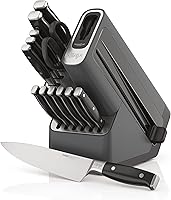
The Ninja NeverDull system is the pick for anyone who wants sharpening handled. Its 14 pieces include an 8-inch chef's knife, an 8-inch bread knife, a 5-inch santoku, a 5-inch boning knife, a 5-inch utility knife, a 3.5-inch paring knife and six steak knives.
The forged German stainless steel blades have a full tang for weight in the hand. The block's built-in stone wheel sharpens at a set angle when you swipe the lever, and Ninja says the edge holds for over 10 years with a 10-year limited warranty.
The trade-off is the extra weight of forged blades and a block that needs the lever used regularly to earn its keep. Its score is 8.4.
The KitchenAid Gourmet set brings forged blades in imported Japanese steel and a wide blade list: an 8-inch chef's knife, an 8-inch slicing knife, a 5-inch santoku, a 5.5-inch serrated utility knife, a 4.5-inch fine-edge utility knife, a 3.5-inch serrated paring knife and a 3.5-inch paring knife. It adds six steak knives, shears and a wood block with a built-in sharpener.
The Eastern-style handles have a satin stainless finish. Two paring knives is unusual and handy, one serrated and one fine edge.
Its score is 8.3.
Which set should you buy?
Buy the set that includes the blades you use, steel and a handle you trust, and a way to keep edges sharp. For most home cooks, that means the Henckels Statement set, because it covers the core blades, adds a honing steel and stores everything in a hardwood block.
Choose the Ninja NeverDull if sharpening is the part you know you will skip. Its built-in wheel makes upkeep a swipe rather than a chore, and the forged blades suit cooks who like a heavier knife.
Choose the KitchenAid Gourmet set if you want forged Japanese steel and a modern block, or if the two paring knives and slicing knife match how you cook. Our professional knife set roundup is the next stop if you want to compare heavier-duty options.
The features on this page are the filter. Apply them to any set you consider, and the question of what makes a good knife set becomes simple: the blades, the build, the grip and the sharpening.
Pick the set that answers all four for your kitchen.
Frequently asked questions
How many knives does a good kitchen set really need?
Four blades cover nearly all home cooking: a chef's knife, a paring knife, a serrated utility or bread knife and a santoku or slicing knife. Everything beyond that is a convenience, so a smaller set with quality steel beats a big set with thin blades.
Is forged better than stamped for a kitchen knife set?
Forged blades are heavier and more balanced for long chopping sessions, while stamped blades are lighter and easier on the wrist. A well-made stamped knife from a known brand holds an edge well, so pick forged only if the extra weight suits how you cut.
Does a built-in sharpener in a knife block actually work?
A built-in sharpener keeps an edge touched up with almost no effort, and it suits households that never reach for a honing steel. A separate steel or whetstone gives more control, so choose based on whether you want convenience or precision.
Can I put kitchen knives in the dishwasher?
Some sets say the blades are dishwasher safe, but hand washing and drying right away protects edges and handles longer. If the maker states dishwasher cleaning is fine, a top-rack cycle still wears edges faster than hand washing.
What should I check first when comparing knife sets?
Start with the blade list: does the set include a chef's knife or santoku plus a paring knife and a serrated blade? Then check construction, handle material, the block's footprint and whether sharpening is included before you compare sets on style.