Are Shun Knives Worth the Money?
Shun knives are worth it if you want a sharp Japanese-style blade, prefer one of these shapes, and will care for it carefully. Choose the Classic chef’s knife for an all-purpose blade, Premier for its hammered finish and contoured handle, or the 3-piece set if you need three useful sizes.
On this page (8 sections)
- Are Shun Knives Worth the Money?
- Are Shun knives worth it for a home kitchen?
- What do Shun’s steel and edge mean for you?
- Is the Shun Classic 3-piece set a good value?
- Is Shun Premier worth choosing over Classic?
- How should you set up and care for a Shun knife?
- Who should skip Shun knives?
- Are Shun knives worth it for your cooking style?
Are Shun Knives Worth the Money?
Shun knives are worth considering if a sharp Japanese-style blade, its handle, and its shape fit your cooking habits. The Classic chef’s knife is a general-purpose choice, Premier adds a hammered finish and contoured handle, and the Classic starter set supplies three common blade sizes.
The best choice depends on what you already own and how you prep food. If an 8-inch chef’s knife would cover most of your work, start there; if you routinely reach for smaller blades too, the 3-piece set may make more sense.
Shun’s appeal is its combination of a VG-MAX core, Damascus cladding, a 16-degree edge, and Japanese craftsmanship. Those features are most useful when you value precise cutting and are willing to handle and store a sharp knife with care.
Are Shun knives worth it for a home kitchen?
They can be a good fit for home cooks who want a sharp all-purpose knife and will use it regularly. The Classic and Premier chef’s knives are both designed for slicing, dicing, and mincing, tasks that make up much of everyday meal preparation.
The Shun Classic 8-Inch Chef’s Knife has a slightly curved blade for rocking through herbs, along with a D-shaped Pakkawood handle. Shun says the knife is handcrafted in Japan and supported by free sharpening and honing.
A single chef’s knife is a practical starting point if you usually prep vegetables, fruit, and proteins with one main blade. It’s less compelling if you already have a chef’s knife you like and are looking only for a specialty blade.
Check the grip before choosing, especially if handle shape matters to you. The Classic’s D-shaped handle is designed for both left- and right-handed users, but the shape should still feel comfortable in your hand.
For a broader look at Japanese-style options, browse our Japanese-style knife set guide. If you’re weighing blade styles, our German vs Japanese knife guide explains the differences that may affect your choice.
What do Shun’s steel and edge mean for you?
The 16-degree edge is a reason to consider Shun if you value a sharp, precise cut. The Classic and Premier chef’s knives combine a VG-MAX core with 68 layers of Damascus cladding.
A sharp knife rewards controlled cuts. Keep the board stable, guide the blade with your other hand curled away from the edge, and avoid twisting the knife sideways while it’s in food.
Use a cutting board that gives the edge a suitable surface, and keep the blade away from hard countertops, bones, and frozen foods. These habits help reduce avoidable edge damage and keep cutting controlled.
Shun says its knives are supported by free sharpening and honing. For care instructions that match the knife, consult Shun Cutlery before choosing a sharpening method.
Are Shun knives worth it if you prefer a santoku?
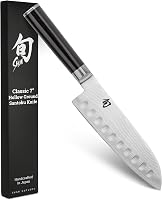
The Shun Classic 7-Inch Santoku may suit you if you want a shorter multipurpose knife for vegetables, fruit, and proteins. Its hollow-ground indentations are designed to reduce friction and help food release from the blade.
At 7 inches, the santoku is shorter than a standard chef’s knife and may feel easier to maneuver for some cooks. Its shape also favors a different cutting motion from the rocking motion many cooks use with a curved chef’s knife.
Choose by how you like to cut, not just by the name of the blade. If you often mince herbs with a rocking motion, the Classic chef’s knife may fit better; if a compact blade feels more natural for your daily prep, consider the santoku.
See what a santoku knife is and whether you need one for more on its shape and uses. You can also read our guide to choosing a chef’s knife by size, steel, and handle if you’re deciding between the two shapes.
Is the Shun Classic 3-piece set a good value?
The Classic 3-piece starter set makes sense if you need a chef’s, paring, and utility knife. It includes an 8-inch chef’s knife, a 3.5-inch paring knife, and a 6-inch utility knife.
The set covers three different kinds of prep without filling your kitchen with a large block. The chef’s knife handles broad daily tasks, while the smaller knives can be useful when a full-size blade feels awkward for precise or compact work.
It is a less useful choice if you already own knives that fill those roles or only need one upgrade. In that case, buying the chef’s knife alone leaves you free to choose any later additions based on actual need.
The three knives share the Classic line’s VG-MAX cores, Damascus cladding, and D-shaped Pakkawood handles. That consistency can appeal if you want the same handle style across your main blades.
Our kitchen knife set buying guide can help you decide whether a set or individual knives suit your kitchen. For a simpler inventory check, see how many knives you really need.
Is Shun Premier worth choosing over Classic?
Choose the Premier chef’s knife if you prefer a contoured handle and hammered tsuchime finish. It shares the Classic chef’s knife’s core steel, cladding, and edge angle, so the main distinction is its handle and surface design.
Shun says the hammered finish helps reduce drag and keep food from sticking to the blade. The Classic has a D-shaped handle, so compare how each handle shape suits your grip rather than treating the Premier as a different class of cutting tool.
Both are 8-inch chef’s knives designed for slicing, dicing, and mincing. If the contoured handle and finish appeal to you, Premier is the more fitting pick; if you prefer the D-shaped handle, choose Classic.
How should you set up and care for a Shun knife?
Give a Shun knife a stable cutting board, a safe storage spot, and a regular care routine. A sharp blade is easier to control when the board does not slide and the edge stays clear of other utensils.
Before prep, place the board on a steady surface and keep a clear area around it. Cut with controlled strokes, and use the blade for food preparation rather than prying, twisting, or scraping hard surfaces.
After use, clean and dry the knife promptly, then store it where the edge won’t strike other metal. A knife block, protective guard, or secure magnetic holder can keep blades separated; our guide to storing kitchen knives safely covers the main options.
Avoid putting a quality knife loose in a drawer, where it can bump against other tools. Also avoid assuming that a sharp edge needs no maintenance: use Shun’s care guidance and sharpening support to plan upkeep.
Who should skip Shun knives?
Skip Shun if you want a low-maintenance knife you can treat roughly or a large collection in one purchase. These picks make most sense when their edge, shape, and handle matter to you enough to care for them thoughtfully.
A cook who needs many specialized blades may find the 3-piece starter set too limited. A cook who already owns a comfortable chef’s knife may not gain much by buying another one with similar everyday uses.
Think about how you prepare food, too. If you prefer a heavier, more sturdy-feeling blade or a different cutting motion, compare styles before buying; our German vs Japanese knife guide can help you sort through those preferences.
Are Shun knives worth it for your cooking style?
Pick the Classic chef’s knife if you want one all-purpose blade, Premier if its contoured handle and hammered finish suit you, and the starter set if you need three core sizes. Choose the Classic santoku if a shorter multipurpose blade matches your cutting style.
Shun knives are worth it when their sharp Japanese-style edges and specific designs fit your routine and you’ll store and maintain them carefully. If you want to compare more Japanese-style options, start with our Japanese-style knife set guide.
Frequently asked questions
Are Shun knives worth the money?
Shun knives can be worth it if you want a sharp Japanese-style blade, handcrafted construction in Japan, and a handle or shape that suits your work. The Classic and Premier chef’s knives are designed for common prep tasks, while the santoku offers a shorter option.
Choose one if those details matter more to you than buying a broad set of knives.
Are Shun knives good for everyday cooking?
Yes. Shun’s chef’s knives are designed for slicing, dicing, and mincing, so they can cover many everyday prep tasks.
The Classic and Premier are both 8 inches long and have a 16-degree edge.
Use a suitable cutting board, keep the edge from hitting other utensils, and choose a blade shape you can control comfortably.
Should I buy a Shun knife set or one knife?
Buy one chef’s knife if you mainly need an all-purpose blade or already own smaller knives. The Classic 3-piece set adds a 3.5-inch paring knife and a 6-inch utility knife to its 8-inch chef’s knife.
Think through your regular prep tasks before paying for three blades.
What is the difference between Shun Classic and Premier?
Both chef’s knives have a VG-MAX core, 68 layers of Damascus cladding, a 16-degree edge, and a Pakkawood handle. The Classic has a D-shaped handle, while the Premier has a contoured handle and hammered tsuchime finish.
Choose based on which handle shape and blade finish you prefer.